|
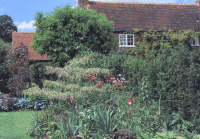
We bought our cottage in its large garden in Spring 1993, wearing rose-tinted glasses. The house needed structural repair and sympathetic attention, while what had once been the garden needed complete redevelopment - our friends referred to it all as a tumbledown shed in an unkempt field.
|
|
We are not professional builders or gardeners, but alongside our day jobs we both worked on taking the cottage apart. Tim then starting rebuilding our home and I started on the garden - mainly clearance work at first and the establishment of a nursery bed for all the plants I found irresistible on my many forays to NGS gardens and hidden nurseries.
|
|
We made a vague plan to begin with, measuring the site and marking out the hedges which we planted first, using yew for the boundary and for internal screening. I put in 12" - 18" plants progressively from 1994, beginning with the front boundary hedge. Almost all have established well, and now the initial plants have reached their desired height. We only trim them once a year, after the wild birds have finished nesting and raising their young.
|
|
The soil here is neutral to mildly acidic badly-draining clay. It has needed copious amounts of grit, sharp sand and organic matter to break it down, and more is added every time something new is planted.
|
|
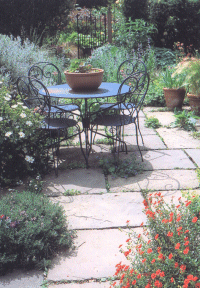
There were few mature trees or shrubs here, but the laurel tree has proved a great focal point in the centre of the dry garden. I started this in 1996 after the previous dry summer when, fearing the failure of many plants, I concentrated on drought-tolerant plants near to the house. These plants are now doing well and are never watered, and the gravel is topped up each spring.
|
|
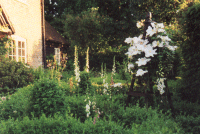
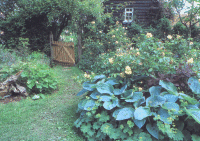
Elsewhere, and despite poor water pressure, we used soaker hoses to establish plantings, but these have now been removed and the plants fend for themselves. The richer plantings - the bog garden and front garden - are dressed with our own compost each year. This has not been an instant garden make-over, and now takes up about half of my time. The plants in the main have been grown from seed or infancy and as you can see have matured well. Some editing now takes place and I find weeding is more a matter of pulling out over-enthusiastic self-seeders such as Ligularia, Verbascums and Oenothera.
|
|
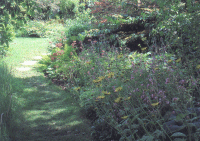
Waterlogging of the yew hedging framing the herbaceous borders was a problem at first, but drainage work carried out in 2002 has prevented further waterlogging. The beds around the lawn have been planted with Carpinus betulus (hornbeam) which is clipped into amorphous shapes and provides a contrast to the more formal Taxus baccata (yew) hedges. I hope that the lawn provides a more tranquil area to contrast with the ebullience elsewhere.
|
|
Last year we revived the pond and planted a new bog garden. The pond was reshaped and relined in the autumn, filling with rainwater during the winter. Although all the plants in the pond are British natives, there are also a few exotics in the bog garden to add interest. As usual, the frogs, newts and toads were no respectors of all this effort and spawned again this year - needless to say, we planted around them.
|
|
This year, our kitchen garden is being remodelled, and we've moved the compost bins from outside the chicken run to inside this area. Sadly, we've said goodbye to our old shed as we needed the space and are awaiting a new, smaller one. To keep Tim busy, we've also decided to resurface the paths and restore the raised beds. Of course, if he's got any time to spare he will be able to work on the new summerhouse!
|
|
We are very fortunate to live here at Rustling End and really appreciate the diversity of fauna and flora which surround us, and the many birds which visit the pond and feeders. We would ask that you too respect this, and hope you will enjoy your visit here.
|